Sunday, February 19

California quake could cause Katrina II

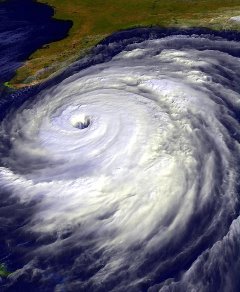
California quake could cause Katrina IIMany densely populated US regions face the threat of flooding as disastrous as after Hurricane Katrina, due to urban spread into river floodplains, scientists warn.

An earthquake or even a moderate flood could destroy the levee system protecting towns and cities along the Sacramento and San Joaquin rivers in northern California, said Jeffrey Mount of the University of California.

"The probability of a catastrophic levee failure in the Sacramento-San Joaquin Delta in the next 50 years is two in three," Mount said on the sidelines of the American Association for the Advancement of Science (AAAS) annual conference.

Mount gave a worrying presentation to the conference entitled "The Sacramento/San Joaquin Delta: the next New Orleans?"

He said one of the frequent earthquakes in California could destroy the levee system that has been built up since the middle of the 19th century, sending flood water over a wide area.

Mount said it could have a similar impact to the Asian tsunami in 2004.
Monday, February 13

Strange new tiny spider found

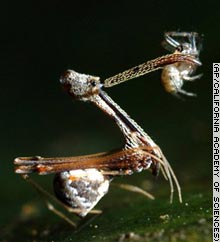
Researchers scouring the remote forests of the African island nation of Madagascar have found that tiny assassin spiders, grotesque-looking bugs that prey on other spiders, are more diverse than previously thought.

The newly discovered species could shed light on how assassin spiders evolved, and perhaps point scientists to other places in Madagascar where other types could be located.

tiny spider
The bizarre-looking assassin spiders were once widely found around the world, but now are found in Madagascar, Australia and South Africa. About a dozen species of assassin spiders were previously discovered.

Sunday, February 12

Mystery reptile lurking around Otay lakes

Fishermen flocking to Otay Lakes are discovering there is more than just fish in the water. The area just opened last week, but instead of talking about fishing, people have something else on their minds, 10News reported. Since June 2005, a creature dubbed "Otayzilla" has been lurking in and around the water.

The mystery monster has been spotted at several places around the lake, which is located just south of Otay Lakes Road in Otay Mesa. "I was actually coming up on a boat at the end of Otay arm," said Jose Gutierrez, a fisherman. "There have been other fisherman who have seen it." It's not quite as scary as Godzilla, but Otayzilla is very real, according to 10News. "I know one fisherman, about a week ago, he said he thought it was an alligator," said Gutierrez. Officials say Otayzilla is not an alligator, but a monitor lizard.


A lot of people haven't seen Otayzilla, but most have heard about it. Several fishermen told 10News they had never seen Otayzilla. Mark Gartland is actually looking forward to seeing the creature. "I hope to see him. I'd like to be able to spot him," Gartland told 10News. Rick Sturm is a herpetoculturist and knows his reptiles, according to 10News. "It does look like a Nile monitor," Sturm said about Otayzilla.

Friday, February 10

Effect of Volcanic Eruption on climate change

Effect of Volcanic Eruption on climate changeVolcanic eruption doesn't have the effect of raising the ocean temperature - on the contrary, it reduces the same Researchers found that ocean warming and sea level rise in the 20th century were substantially reduced by the 1883 eruption of the Krakatoa volcano in Indonesia. Volcanic aerosols blocked sunlight and caused the ocean surface to cool.
"That cooling penetrated into deeper layers of the ocean, where it remained for decades after the event," said Peter Gleckler, an atmospheric scientist at Lawrence Livermore National Laboratory (LLNL). "We found that volcanic effects on sea level can persist for many decades.

Tuesday, February 7

Protection asked for Arkansas woodpecker

Protection asked for Arkansas woodpeckerA federal judge has been asked to stop a $319 million eastern Arkansas public works project to protect the newly discovered ivory-billed woodpecker.

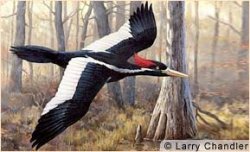
'Campephilus principalis' - the ivory-billed woodpecker - is among the world’s largest woodpeckers.National Wildlife Federation feared that the Grand Prairie irrigation construction project would damage the habitat of the bird that was believed extinct until sighted last spring.

Though the Federal attorneys argued that without the project, the region's underground water source could disappear in a decade. The final decision will be taken by the judge after a detailed study of the project papers. Hope a way will come out soon to protect the Ivorybill and other treasures of the region.

Source : ScienceDaily.com

'Lost world' found in Indonesian jungle

Lost world found in Indonesian jungleScientists said on Tuesday they had found a "Lost World" in an Indonesian mountain jungle, home to dozens of exotic new species of birds, butterflies, frogs and plants.

"It's as close to the Garden of Eden as you're going to find on Earth," said Bruce Beehler, co-leader of the U.S., Indonesian, and Australian expedition to part of the cloud-shrouded Foja mountains in the west of New Guinea.

Indigenous peoples living near the Foja range, which rises to 7,218 ft, said they did not venture into the trackless area of 1,200 sq miles -- roughly the size of Luxembourg or the U.S. state of Rhode Island.

The team of 25 scientists rode helicopters to boggy clearings in the pristine zone.

"We just scratched the surface," Beehler told Reuters. "Anyone who goes there will come back with a mystery."

The expedition found a new type of honeyeater bird with a bright orange patch on its face, known only to local people and the first new bird species documented on the island in over 60 years. They also found more than 20 new species of frog, four new species of butterfly and plants including five new palms.

And they took the first photographs of "Berlepsch's six-wired bird of paradise," which appears in 19th century collections but whose home had previously been unknown.

The bird is named after six fine feathers about 4 inches long on the head of the male which can be raised and shaken in courtship displays.

continued....

Monday, February 6

Global warming threatens new Qinghai-Tibet rail link

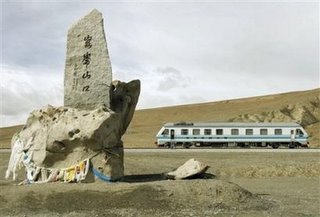
global warmingGlobal warming could threaten the new Qinghai-Tibet Railway, the world's highest, within a decade, a Chinese researcher said in remarks published on Sunday.

Wu Ziwang, a frozen soil specialist at the Chinese Academy of Sciences, told the official Xinhua news agency his research over three decades revealed large areas of the Qinghai-Tibet plateau showed signs of shrinking, as they were frozen less of the time.

This could threaten the new railway, which is to start operations this year, Wu said.

"Fast thawing of frozen soil in the plateau might greatly increase the instability of the ground, causing more grave geological problems in the frozen soil areas where major projects such as highways or railways run through," Wu added.

A separate report by the academy's desert institute showed that temperatures on the plateau have been rising markedly since 1984 and that winter temperatures could rise by another 1-2 degrees Celsius by 2050.

China completed construction of the controversial pan-Himalayan railway in October. It is to go into trial operation on July 1, Xinhua said.

Wu is not the first Chinese researcher to warn that the project could be threatened by rising temperatures, but he forecasts it happening earlier than previously estimated.

State media quoted Luo Yong, deputy director of China's National Climate Center, as saying last June that rising temperatures on the plateau could affect safe operation of the railway by 2050.

Source: Reuters.

Saturday, February 4

Wind farm causes eagle deaths

Wind farm causes eagle deathsFour have been found dead. Almost 30 are missing on isolated islands off the Norwegian coast.

The dead white-tailed eagles were found between August and December 2005. Two had been sliced in half, apparently by a turbine blade. Post mortems blamed multiple trauma for the birds' deaths, caused by a heavy blow. Much of the wind park is remote and rarely visited and it is possible that other deaths have gone undetected.

The White-tailed Eagle 'Haliaeetus albicilla' is found in significant numbers on Smola, a set of islands about ten kilometres off the north-west Norwegian coast. The island is listed by BirdLife as an Important Bird Area (IBA) because it holds one of the highest breeding densities of the species in the world.

The 68-turbine Smola wind farm was built between 2001 and 2005. The Norwegian government ignored advice based on an environmental assessment, warning against the development because of the danger it posed to White-tailed Eagles.

BirdLife supports the generation of wind and other renewable energies to help tackle climate change but these interim research results have underlined the dangers of wind parks placed near sites that birds instinctively seek.

Source : BirdLife International.