Brazilian paleontologists have discovered a new giant dinosaur species based on fossilized fragments of the herbivorous reptile that lived 80 million years ago.
The Maxakalisaurus topai, of the Titanosauria group, was 13 meters (yards) long and weighed about nine tons.
It had a large body, long tail and neck with a relatively small head. Some of the bones found had the marks of teeth on them, which led scientists to believe that the specimen was devoured by carnivorous dinosaurs after its death.
The fossils date back to the Late Cretaceous period. They were found during excavations between 1998 and 2002 next to a highway in a place called Serra da Boa Vista in central-southern Minas Gerais state. It then took some time for the scientists to categorize the species and reconstruct the skeleton.
The name of the species, Maxakalisaurus topai, derives from an Indian tribe, Maxakali, which lives in the area. Topa is a divinity that the tribe worships. It is a custom in Brazil to give native Indian names to paleontological finds.
Technorati Tags: Maxakalisaurus topai, Fossil, Brazil, Paleontology, Dinosaur
Ice Age gives clues to global warming: study
Ice Age evidence confirms that a doubling of greenhouse gases could drive up world temperatures by about 3 Celsius (5.4 Fahrenheit), causing havoc with the climate, a study showed on Friday.
The researchers made a novel check of computer climate forecasts about the modern impact of heat-trapping gases, widely blamed on use of fossil fuels, against ice cores and marine sediments from the last Ice Age which ended 10,000 years ago.
"A doubling of carbon dioxide concentrations would cause a global temperature increase of around 3 Celsius," said Thomas Schneider of the Potsdam Institute for Climate Impact Research who led the report.
Technorati Tags: global warming, climate change, science, environment
The researchers made a novel check of computer climate forecasts about the modern impact of heat-trapping gases, widely blamed on use of fossil fuels, against ice cores and marine sediments from the last Ice Age which ended 10,000 years ago.
"A doubling of carbon dioxide concentrations would cause a global temperature increase of around 3 Celsius," said Thomas Schneider of the Potsdam Institute for Climate Impact Research who led the report.
Technorati Tags: global warming, climate change, science, environment
A rare Sumatran tiger was shot and killed by the head of a Florida zoo
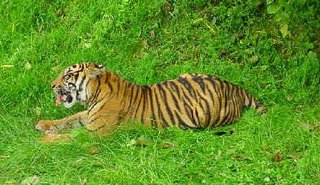 A rare Sumatran tiger was shot and killed by the head of a Florida zoo after it escaped from its cage and charged at a veterinarian, zoo officials said.
Enshala, a 180-pound (81 kg) female tiger, was being put into her night house when she slipped past an unlocked latch and headed toward a public area on Tuesday. A veterinarian shot Enshala with a tranquilizer dart but she then charged at him, and zoo president Lex Salisbury killed her with a shotgun.
"I feel sick to my stomach," Salisbury, head of the Lowry Park Zoo in Tampa, told the St. Petersburg Times. He said he felt he had to shoot to protect the veterinarian.
Sumatran tigers are found in the wild only on the Indonesian island of Sumatra, where fewer than 500 remain, according to the World Wildlife Federation.
image : ©wildanimalpark.co.uk
Drought, water worries cloud skies for US farmers
 As the United States bakes in one of the hottest summers since the Dust Bowl years of the 1930s, drought from the Dakotas to Arizona through Alabama has sharpened the focus of farmers on their lifeline- water.
Eighty percent of all fresh water consumed in the United States is used to produce food. But years of drought, diversion of water to growing urban areas and, most lately, concerns about global warming are feeding worries.
Specifically, farmers fear the U.S. Plains is facing its limits as a world producer of wheat, beef, vegetable oils and other crops due to long-term water shortages.
"Farmers aren't going to be able to produce enough food to feed the world because there's a finite amount of water left in the world. There are many folks that will tell you the next war will not be over gold, silver or land, it will be over water," said Ed Burchfield, director of facilities for Valmont Industries, which makes irrigation equipment.
img : ©www.co.larimer.co.us
Greenland's glaciers have been shrinking for 100 years
 Greenland's glaciers have been shrinking for the past century, according to a Danish study, suggesting that the ice melt is not a recent phenomenon caused by global warming.
Danish researchers from Aarhus University studied glaciers on Disko island, in western Greenland in the Atlantic, from the end of the 19th century until the present day.
"This study, which covers 247 of 350 glaciers on Disko, is the most comprehensive ever conducted on the movements of Greenland's glaciers," glaciologist Jacob Clement Yde, who carried out the study with Niels Tvis Knudsen, told AFP.
Using maps from the 19th century and current satellite observations, the scientists were able to conclude that "70 percent of the glaciers have been shrinking regularly since the end of the 1880s at a rate of around eight meters per year," Yde said.
"We studied 95 percent of the area covered by glaciers in Disko and everything indicates that our results are also valid for the glaciers along the coasts of the rest of Greenland," he said.
The biggest reduction was observed between 1964 and 1985.
"A three-to-four degree increase of the temperature on Greenland from 1920 to 1930, and the increase recorded since 1995 has sped up the ice melt," he said.
Ozone-friendly chemicals lead to warming
 Cool your home, warm the planet. When more than two dozen countries undertook in 1989 to fix the ozone hole over Antarctica, they began replacing chloroflourocarbons in refrigerators, air conditioners and hair spray.
But they had little idea that using other gases that contain chlorine or fluorine instead also would contribute greatly to global warming.
CFCs destroy ozone, the atmospheric layer that helps protect against the sun's most harmful rays, and trap the earth's heat, contributing to a rise in average surface temperatures.
image source: dailytimes.com
China to let tourists hunt endangered species
China is to auction licenses to foreigners to hunt wild animals, including endangered species, a newspaper said on Wednesday.
The government would auction licenses based on types and numbers of wild animals, ranging from about $200 for a wolf, the only carnivore on the list, to as much as $40,000 for a yak, the Beijing Youth Daily said.
The auction, taking place on Sunday in Chengdu, capital of the southwestern province of Sichuan, would be the first of its kind in Chinese history, it added.
"Some animals are from the first and second category of national wildlife protection, but with the strict limitations in place, the hunting could not destroy wild animal populations," the daily said.
More
The government would auction licenses based on types and numbers of wild animals, ranging from about $200 for a wolf, the only carnivore on the list, to as much as $40,000 for a yak, the Beijing Youth Daily said.
The auction, taking place on Sunday in Chengdu, capital of the southwestern province of Sichuan, would be the first of its kind in Chinese history, it added.
"Some animals are from the first and second category of national wildlife protection, but with the strict limitations in place, the hunting could not destroy wild animal populations," the daily said.
More
Nepal makes drug to halt vulture decline
 Nepal has begun producing a new cattle drug intended to halt a big decline in endangered vultures, which were being poisoned by a previous version when they fed off carcasses of farm animals, conservationists said on Friday.
A local company in Nepal has begun production of meloxicam, which is considered a safe alternative for anti-inflammatory diclofenac used earlier by farmers in the region, said Hem Sagar Baral of the Birds Conservation Nepal.
Diclofenac was widely used to treat many types of ailments in farm animals, but research showed that it was responsible for the deaths of vultures who fed off the carcasses of these animals.
The US-based Peregrine Fund, which is working to conserve birds of prey, has reported that South Asia's vulture population plunged by an alarming 95 percent since 1995. It said the widespread use of diclofenac was directly responsible for the decline.
Conservationists campaigned to ban diclofenac in Nepal, and the government responded by banning its import and its production in the country.
Source
Subscribe to:
Posts (Atom)